

Server Rack Cooling
How heat leaves the cabinet, from a single fan to a cooled data center row
Server rack cooling decides how long IT hardware lives. Every watt a server, switch or storage system draws ends up as heat inside the cabinet, and that heat has to leave before it shortens the life of the components. The right method depends on the heat load, the room and the noise you can accept.
For small loads, fans and PWM fan control are often enough. Higher loads need a cabinet with an integrated cooling unit, a top-mounted unit or a closed cabinet with its own climate system. For high densities, water cooling and hot and cold aisle containment keep whole rows stable. Cold or humid sites can also need heating.
Lehmann IT has built server cabinets in its own production in Salach, Germany, since 1983. The questions below explain each cooling method in detail. Pick the one that matches your situation.
Ready to choose? These shop categories show the matching products with prices and configuration options.
Air-conditioned server cabinets →Precision cooling →Hot / cold aisle containment →The most important questions on cooling a server cabinet, server room and data center, answered briefly by Lehmann IT.
Servers, routers and switches turn almost all the power they draw into heat, and that heat builds up inside the cabinet. High temperatures cut performance, damage electronics and cause outages. Downtime and lost data usually cost more than the cooling.
Passive ventilation through perforated doors is enough only for low heat loads in a clean room. From roughly 1,000 watts total load in the cabinet, we recommend an air-conditioned server cabinet with active cooling.
It follows the heat load, which is roughly the combined power draw of every device in the cabinet. Choose a little more rather than a little less, as reserve for new servers and hot summers. We are glad to work it out with you: ask us, free of charge.
DX cabinets work with refrigerant and an outdoor unit, up to 14 kW. Where the building already has chilled water, CW cabinets cool up to 35 kW, and the RearCool rack can even be retrofitted without downtime.
The heat load in the cabinet is roughly the power draw of all the devices in it. Hover over a bar or click it.
Scale 0 to 60 kW. Our recommendation: pick a little more cooling capacity than you need today, as reserve for new servers and hot summers.
Two rows of cabinets stand front to front. The aisle between them is enclosed, so cold and warm air no longer mix and the cooling unit works far more efficiently.
More on containment: cold aisle and hot aisle containment.

For 1 to 4 kW a compact unit on the cabinet is enough, with a side or roof cooling module, and no separate air conditioning in the room. More on air-conditioned server cabinets.
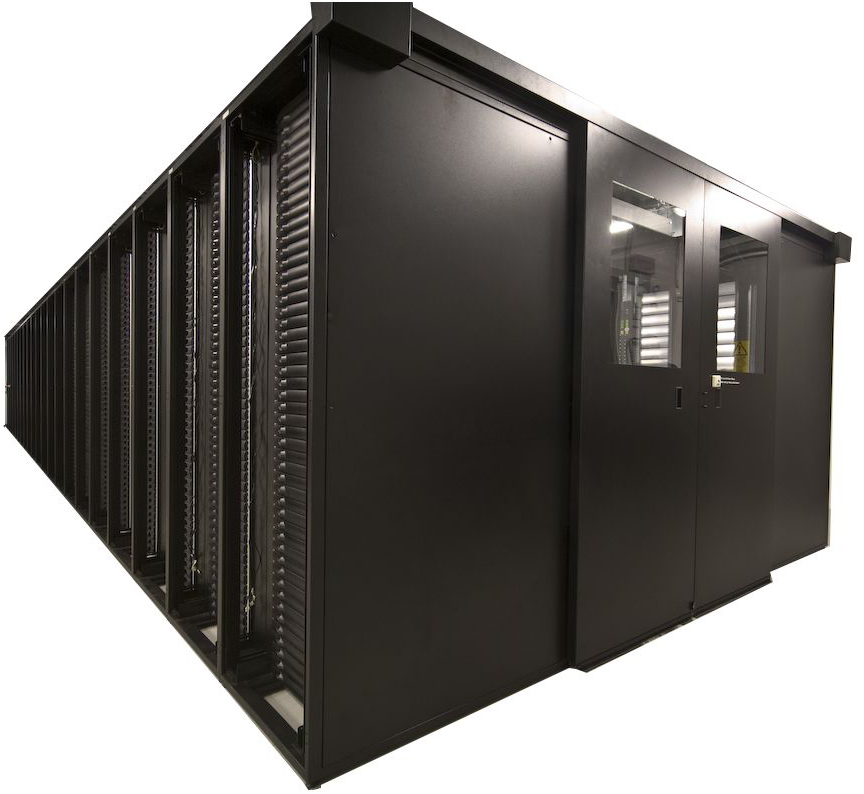
Containment separates cold and warm air and raises efficiency in the data center. We plan it to match your racks: cold and hot aisle containment.
Nearly all electrical power drawn by IT equipment becomes heat. A cabinet whose devices draw 3 kW produces about 3 kW of heat. That figure is the starting point for every cooling decision, so it pays to measure or add up the real power draw instead of guessing from the number of devices.
Fans are enough when the room itself stays cool and the heat load is moderate. They move room air through the cabinet but cannot cool below room temperature. If the room warms up in summer or the load grows, the cabinet needs active cooling such as an integrated cooling unit or a top-mounted unit.
An integrated cooling unit sits in the side or door of the cabinet and cools the air in a closed circuit. A top-mounted unit sits on the cabinet roof and blows cooled air down into the cabinet. Both keep the equipment independent of the room temperature; the choice depends on space, access and heat load.
Water carries heat far better than air. Water cooling makes sense for high heat densities, for rooms where the warm air must not stay in the room, and for data centers that already have a chilled water supply. It needs more planning but keeps dense installations stable.
Without separation, warm exhaust air mixes with cool supply air and the cooling has to work harder. Hot and cold aisle containment keeps the two air streams apart, so the cooling reaches the equipment intakes directly and the whole room runs more efficiently.
Yes. In unheated rooms, outdoor sites or cold warehouses, temperatures can fall below what the equipment tolerates, and condensation can form when warm and cold air meet. Cabinet heaters and climate control keep the temperature and humidity in a safe range all year.
Cooling that matches the load wastes less energy. Controlled fans run only as fast as needed, closed cabinets cool only the equipment instead of the whole room, and containment stops cold air from mixing with warm air. Together these measures lower running costs and help meet efficiency rules.
Lehmann IT has designed and built server cabinets in its own production in Salach, Germany, since 1983. Because development and manufacturing sit under one roof, standard cabinets can be adapted and special versions built when a project needs them. This knowledge site explains the technology in depth, so you can understand the options before you decide. When you know what you need, the Lehmann IT shop at lehmann-it.de shows the matching products with prices and configuration options, and the team in Salach helps with questions on cooling by phone or email.
Hit enter to search or ESC to close