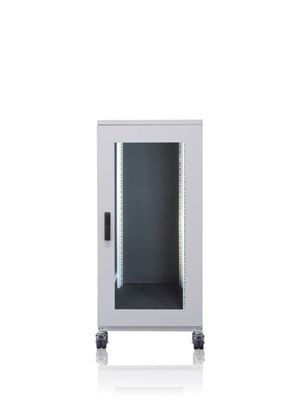
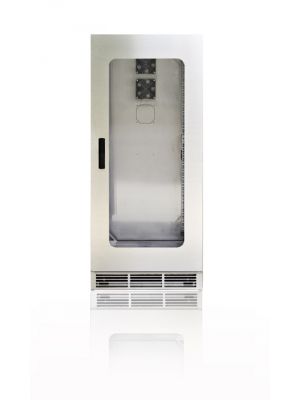
How PWM Fan Technology Works in Racks
Smart Fan Regulation.
PWM fan technology: fan speed follows the actual heat, so the cabinet stays cool, quieter and more energy efficient.
Server cabinets equipped with PWM fan systems offer a clear technical advantage over conventional fixed-speed ventilation. Instead of running at a constant RPM, PWM-controlled fans adjust their speed dynamically based on the actual temperature inside the cabinet. This creates a more efficient, quieter and more stable cooling environment for IT hardware.
One of the main benefits is the significant reduction in noise. In acoustic and office environments, low sound levels are essential. PWM fans operate at reduced speed when the thermal load is low, which keeps the cabinet extremely quiet during normal operation. When more cooling is required, the fans increase their speed smoothly without sudden jumps in noise. This makes PWM ventilation ideal for office racks, studio racks and mixed-use rooms where people work close to the equipment.
Another major advantage is the improvement in temperature stability. The integrated PWM controller constantly monitors the internal temperature and adjusts the fan speed automatically. This prevents heat buildup, protects sensitive components and ensures reliable long-term operation. By maintaining a controlled temperature range, PWM cooling systems reduce the risk of thermal stress and extend the lifespan of servers, switches and network devices.
Energy efficiency is also a key factor. Because the fans only run as fast as necessary, PWM fan systems consume less power than traditional fixed-speed fans. This is especially beneficial in cabinets that operate continuously, such as acoustic racks or office racks with limited natural airflow. Lower energy consumption also means less heat generated by the fans themselves, further improving overall cooling performance.
Lehmann IT cabinets are designed to work seamlessly with PWM fan modules, ensuring that warm air is extracted efficiently while fresh air is drawn in through the designated intake areas. This controlled airflow pattern supports both cooling performance and noise reduction. Whether installed in an office, a studio or a technical room, PWM-equipped cabinets provide a stable, quiet and energy-efficient environment for IT equipment.
If you want to upgrade an existing cabinet or configure a new one, Lehmann IT offers several options for PWM fan integration, including complete systems with controller and installation. These solutions are engineered to match the airflow design of the cabinet and deliver consistent performance in demanding environments.
For customers who need quiet operation, precise temperature control and long-term reliability, PWM fan technology is the most effective ventilation solution available for Lehmann IT server cabinets.
Contact us today to learn how PWM fan systems can improve the performance and noise levels of your Lehmann IT cabinet and to find the right configuration for your installation.
The heat load in the cabinet is roughly the power draw of all the devices in it. Hover over a bar or click it.
Scale 0 to 60 kW. Our recommendation: pick a little more cooling capacity than you need today, as reserve for new servers and hot summers.

For 1 to 4 kW a compact unit on the cabinet is enough, with a side or roof cooling module, and no separate air conditioning in the room. More on air-conditioned server cabinets.
Pulse width modulation. The controller switches the fan supply on and off very quickly, and the ratio of on to off time sets the speed. This allows smooth speed changes instead of just on and off.
The fans only run as fast as the heat requires. That lowers noise, reduces energy use and extends fan life, while the temperature inside the cabinet stays stable.
In office and soundproof cabinets, in network cabinets and anywhere noise and energy matter. It is an upgrade over the standard and thermostat fans.
No. Like all fans, PWM fans use room air. When the room is too warm or the load too high, air-conditioned cabinets are needed.
PWM fans and controls in the Lehmann IT shop
Lehmann IT supplies PWM fan units and controls for its server cabinets. See every model and option in the shop.
Every topic explained in depth, with the matching products in the Lehmann IT shop.
Hit enter to search or ESC to close